What are Food-Grade Plastics?
Food-grade plastics are plastic materials suitable for contact with food or drink under specific conditions. They are widely used throughout food processing, beverage production, commercial kitchens and packaging lines.
From chopping boards and conveyor guides to precision-machined parts, tanks and machine guards, plastics provide practical solutions for hygiene-sensitive environments.
At Oadby Plastics, we supply, machine and fabricate a wide range of plastic materials for the food and beverage industry.
Food-grade plastic is a commonly used term for a plastic grade intended to meet the relevant requirements for contact with food.
For a material to be suitable, it must not transfer substances to food at levels that could:
Food contact suitability applies to the specific material grade rather than the type of plastic alone.
For example, one polyethylene (PE) grade may be suitable for food contact while another containing different additives, colourants or recycled content may not be. Individual materials’ datasheets should always be checked to confirm the suitability for their application.
The terms are often used interchangeably, but they describe slightly different considerations.
Food grade usually refers to the composition and compliance status of the material.
Food safe considers whether the finished component is suitable for the way it will actually be used.
A food contact-approved plastic may not be suitable for every temperature, food type or cleaning process. The complete application must therefore be assessed before a material is chosen
Several thermoplastics are available in food contact grades. Each provides a different balance of wear resistance, strength, chemical resistance, temperature performance and machinability.
Polyethylene
Polyethylene is widely used throughout food production because selected grades combine low moisture absorption with impact resistance, chemical resistance and useful sliding properties.
Different grades are available for different requirements:
Typical applications include chopping boards, conveyor guides, wear strips, star wheels, liners and product-handling components.
Acetal
Acetal, also known as POM, is a strong and dimensionally stable engineering plastic with good machinability and low moisture absorption.
Food contact grades are commonly machined into:
Metal-detectable acetal is also available for food processing and packaging applications where contamination-control systems are in place.
Polypropylene
Polypropylene is a lightweight and weldable thermoplastic with good resistance to many chemicals.
Suitable food contact grades can be used for:
Its chemical resistance makes it a useful option in environments subject to regular cleaning. Compatibility with the particular cleaning products and operating temperatures should still be confirmed ahead of use.
PETG
PETG is a transparent thermoplastic that combines impact resistance with good fabrication and thermoforming properties.
Food contact-approved PETG can be used for display equipment, protective screens, covers and machine guards where visibility is required.
Metal-detectable plastics
Metal-detectable plastics contain specialist additives designed to help compatible detection systems identify material fragments.
They are commonly supplied in blue to make visual identification easier and can be used for components such as:
Detection performance depends on the equipment used, sensitivity settings and size of the fragment. The material should be checked using the facility’s actual detection system ahead of use to ensure it meets business needs.
| Material | Common reasons for selection | Typical applications |
| PE-HD | Lightweight, weldable and chemically resistant | Tanks, trays, covers and fabricated parts |
| PE 500 | Impact and abrasion resistance | Chopping boards, guides and wear components |
| PE 1000 | Low friction and excellent wear resistance | Wear strips, liners and conveyor components |
| Acetal | Dimensional stability and machinability | Gears, rollers, bushes and precision parts |
| Polypropylene | Chemical resistance and fabrication properties | Tanks, containers and welded equipment |
| PETG | Transparency, impact resistance and easy fabrication | Guards, screens and display equipment |
| Metal-detectable grades | Support for contamination-control systems | Scrapers, guides and processing components |
The best material will depend on the complete application rather than one property alone.
Food contact plastics are used across food and beverage handling, preparation, processing and packaging.
Food preparation surfaces – Food contact-grade polyethylene can be used for chopping boards and preparation surfaces in commercial kitchens, bakeries, butcheries and food production facilities. Boards can be supplied in standard or custom sizes, with different colours available to support organised food preparation procedures.
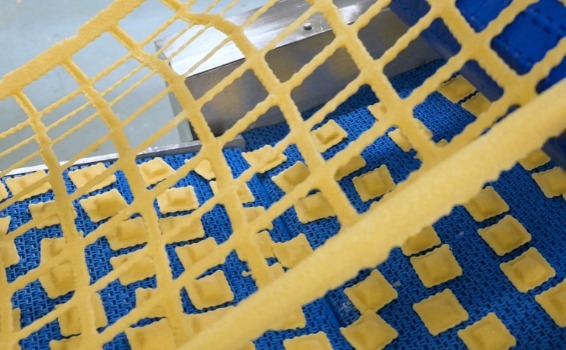
Conveyor components – Low-friction and wear-resistant plastics are frequently used for wear strips, guide rails, chain guides and change parts. These components help products and packaging move consistently through food processing, bottling and packaging lines. Through Oadby Conveyors, we can also support manufacturers with conveyor systems, modular belting, components and belt assembly.
Machined components – Engineering plastics can be machined into components such as gears, rollers, bushes, bearings, spacers and guides. Depending on the application, plastics can provide lower weight, corrosion resistance, reduced friction and quieter operation compared with some metal components.
Tanks and fabricated equipment – Weldable thermoplastics such as suitable polyethylene and polypropylene grades can be fabricated into tanks, trays, chutes, covers and other production equipment.
Machine guards and screens – Transparent materials such as PETG can be used for guards, covers and screens around processing and packaging machinery. The material should be selected according to the required impact resistance, visibility, temperature performance and cleaning regime.
No single material is suitable for every food and beverage application. Before choosing a grade, consider the following factors.
Type of food – Dry, aqueous, fatty and acidic foods can interact with materials differently.
Contact time and temperature – Short-term contact at room temperature is different from repeated contact with hot food, steam or chilled products.
Cleaning chemicals – Confirm that the material can withstand the detergents, disinfectants and sanitisers used within the facility, including their concentration and operating temperature.
Wear and friction – Moving components may require low friction, abrasion resistance or good impact performance to achieve a practical service life.
Mechanical load – Consider the weight, pressure and repeated loads placed on the component. Materials that perform well as wear strips may not provide the stiffness required for precision parts.
Moisture absorption – Some plastics absorb more moisture than others, which can influence their dimensions and mechanical properties.
Detectability – Metal-detectable or visually detectable plastics may be appropriate for components positioned near open food or within processing equipment.
Documentation and traceability – It is important to reference the precise grade and request the relevant food contact documentation, and not to assume that every grade or colour within a material family has the same approval status.
Since 1969, we have supported customers across UK manufacturing with material supply, technical guidance and specialist plastic processing.
Our food and beverage offering includes:
With extensive UK stockholding and in-house machining capabilities, we can support projects from initial material selection through to finished components.
Choosing a food-grade plastic requires more than identifying a familiar material. The grade must be suitable for the food, temperature, cleaning process and mechanical demands of the application.
Whether you need plastic sheet, rod, chopping boards, conveyor components or bespoke machined parts, our team can help you compare suitable options.
Contact our team to discuss your food and beverage application with our experienced team.